High Ticket Dropshipping Suppliers: The Dealer Form, Emails And Calls That Got Me Approved

By Jako
Published November 10, 2026
In Short
- The best high ticket dropshipping suppliers are US manufacturers with a dealer program. You buy at dealer price, list at MAP, and they ship from their own warehouse.
- I find them with the competitor web: find online-only stores selling the products, list the brands they carry, and look each brand up. Those brands already work with dealers who don't hold stock.
- In my first round I contacted about 15 manufacturers and about 10 said yes. Dealer forms usually got approved in 1 to 2 days.
- Walk away from a supplier with under 20% margin, no MAP policy, or products shipped from overseas.
Contents
- Who This Supplier Guide Is For
- What Is A High-Ticket Dropshipping Supplier?
- How Do I Find High Ticket Dropshipping Suppliers?
- Where Do You Buy For Dropshipping High-Ticket Products?
- Why I Won’t Give You A High Ticket Dropshipping Supplier Directory
- How I Get Approved: Dealer Form, Email Or Call
- What Do Suppliers Check Before They Say Yes?
- Red Flags In High Ticket Dropshipping Suppliers
- How Do You Pay High-Ticket Dropshipping Suppliers?
- What I’d Do This Week
- FAQ
Most guides on high ticket dropshipping suppliers don’t show a real approval or tell you what to say.
I’ve been through supplier sign-ups since my first cold call. My store has done $3M+ in sales since January 2025, mostly to businesses, and I’ve never held one product. These are my results, not a promise of what you’ll make.
Here’s exactly how I find high ticket dropshipping suppliers, get approved, and decide who’s worth keeping. With the real dealer form and emails (brand blacked out).
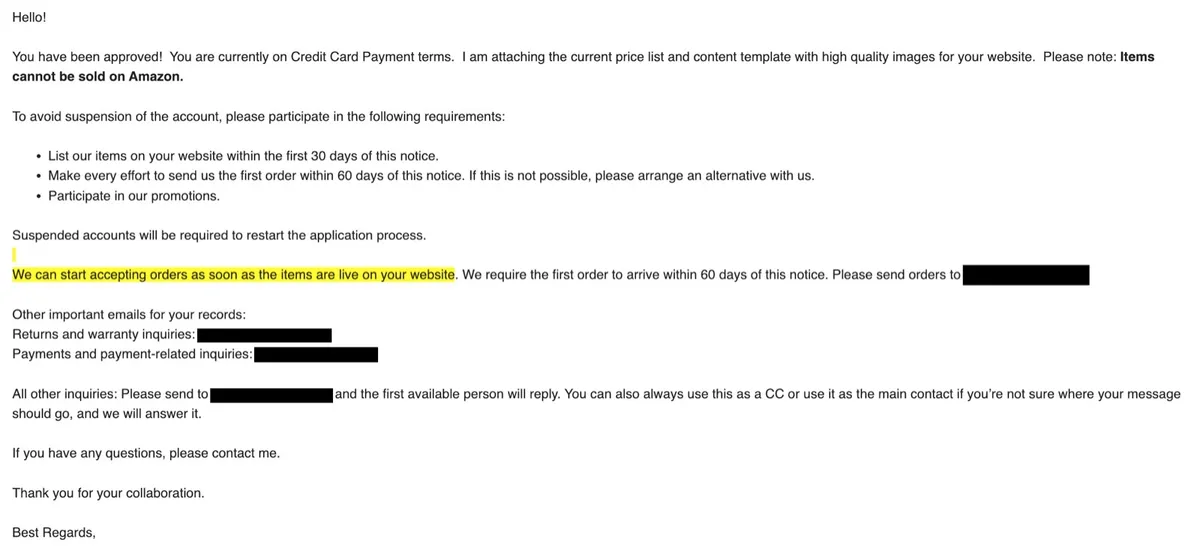
A real approval from one of my suppliers. I black out the brand to keep my niche private.
Who This Supplier Guide Is For
It’s for you if:
- You want to sell $1,000+ products to businesses, not $20 gadgets.
- You’re ready to fill in dealer forms, send emails, or pick up the phone.
- You have a niche, or you’re about to pick one.
It’s not for you if:
- You want a ready-made list to copy. (More on why below.)
- You want to buy stock and ship it yourself.
- You want to sell on Amazon. Some brands, like the one below, won’t approve Amazon sellers.
New to the model? Start with how to start high ticket dropshipping, then come back here for step 5.
What Is A High-Ticket Dropshipping Supplier?
A high-ticket dropshipping supplier is a manufacturer or brand that lets an online store sell its products, then ships each order straight to the store’s customer.
You become one of their dealers. They give you a dealer price (what you pay) and an MSRP or MAP (what you list it at). MAP means minimum advertised price. Nobody can advertise it cheaper, so competition stays even.
The money works like this. A business orders on your site and pays you. You send the manufacturer a purchase order at your dealer price, with the customer’s address. They ship it from their warehouse. You keep the difference.
“Dropshipping is just a method of fulfillment.” Lots of manufacturers already work this way because it’s efficient. They get revenue, less work, and a retailer growing their brand with its own ad money.
So you’re not begging for a favor. You’re bringing them a sales channel.
The Types Of Supplier, Compared
| Supplier type | Where it ships from | Price protection | My take |
|---|---|---|---|
| US manufacturer with a dealer program | Its own US warehouse, fast | MAP, so prices stay even | What I use |
| Distributor (carries many brands, sells to dealers) | Its warehouse | Depends on each brand | Not what I use. I sign with manufacturers direct |
| Overseas marketplace (AliExpress style) | Mostly China | Usually none | Nothing. Long transit, quality issues, painful returns |
| Private label (your brand on their product) | Varies | You set it | Nothing. I sell the manufacturer’s own brands |
High-ticket works because buyers search Google for real brands and model numbers. You capture demand that already exists. You only need a little of it.
How Do I Find High Ticket Dropshipping Suppliers?
Here’s how to find high ticket dropshipping suppliers the way I find mine. I call it the competitor web, and it’s the part nobody else explains.
Step 1: Find Stores Already Selling Your Products
Google a product your niche’s buyers need. Open the stores that come up. You want at least 5 competitors selling the same kind of products.
Step 2: Check If The Store Is Online Only
Look at the store’s address. Is there a showroom, or is it just an office?
If a store is online only, “this is gold.” Every brand it carries already works with online dealers who don’t hold stock. That’s exactly what you are.
Step 3: List Every Brand They Carry
Write down every brand on the site. Online stores carry many brands, so one competitor can give you a long list.
Step 4: Look Up Each Brand
Go to each brand’s own website. Look for a dealer form, a “become a dealer” page, a dealer email or a phone number. Any of those is a green flag. It means they have a system for taking on new dealers.
Step 5: Find The Other Stores Carrying That Brand, And Repeat
Search the brand name and see who else sells it. Those stores carry other brands. Look those up too.
“You will start to unfold a web of suppliers.” After a few rounds you’ll have a long list, and every name on it already works with stores like yours.
Save every brand’s contact details in a Google Sheet as you go: brand, contact, phone or email, date contacted, status, follow-up date and notes.
What If You Haven’t Picked A Niche Yet?
Do that first. You can’t find suppliers without a niche, and the supplier count is part of how you pick one. My test needs at least 20 manufacturers in the niche. The full checklist is in my step-by-step guide to starting.
My public example niche is restaurant equipment: prep tables, deep fryers, ovens and refrigerators. Run the competitor web on any niche like that and you’ll see how fast the list grows.
Where Do You Buy For Dropshipping High-Ticket Products?
Buy from the manufacturer, at dealer price, after your customer has paid you. You never buy stock first.
That’s the short answer to where to buy for dropshipping when the products cost $1,000+.
Why I Use High Ticket Dropshipping Suppliers In The USA
My suppliers are US manufacturers shipping to US buyers, mostly businesses. Here’s why:
- Fast processing and shipping. Orders go out from a US warehouse, not across an ocean.
- They arrange the freight. My manufacturers have discounted freight and carrier accounts and scheduled pickups. I pay for shipping, but they handle it.
- Damage gets sorted. A carrier once dropped a unit, and the customer’s Ring camera caught it. The supplier shipped a new one free of charge.
- Evergreen products. Businesses keep needing this equipment. There’s no trend to crash.
So the best USA high ticket dropshipping suppliers aren’t a secret group of companies. They’re the US brands in your niche that have a dealer program, a MAP policy and a real warehouse. That’s what “high ticket dropshipping suppliers USA” should mean when you search for it.
High Ticket Dropshipping Suppliers That Ship Fast
You’ll find out how fast a supplier ships before you sign. Ask:
- How many business days to process an order?
- Do they ship freight or parcel, and from where?
- Do they use their own carrier accounts, or yours?
The account forms email further down asks exactly that: use their FedEx or UPS account, or yours.
Finding Niches By Type Of Buyer
When I look for high ticket dropshipping niches USA suppliers already serve, I start from the buyer. Walk into any business and look around. What equipment is in there? What does it cost? Who makes it?
Restaurants, gyms, schools, hotels and offices all buy $1,000+ equipment. Each one is a niche to run the competitor web on.
Why I Won’t Give You A High Ticket Dropshipping Supplier Directory
You’ve probably searched for a high ticket dropshipping supplier directory, or a “best high ticket dropshipping suppliers 2026” list.
I won’t give you one, and here’s why.
- The right suppliers depend on your niche. A list for my niche is useless for yours.
- A public list means public competition. Everyone using the same list applies to the same brands. Some brands already say no because they have too many dealers.
- The competitor web finds better ones. It only turns up brands that already work with online-only dealers, in your niche, right now.
You don’t need to pay for a directory to find high-ticket dropshipping suppliers (or “high ticket drop shipping suppliers”, however you spell it). You need a niche and about a week with Google.
How I Get Approved: Dealer Form, Email Or Call
There are three ways in. Use all three.
1. The Online Dealer Form
This is my favorite. A lot of manufacturers have a dealer application right on their website. Fill it out, submit it, and no phone call is needed.
Mine usually got approved in 1 to 2 days.
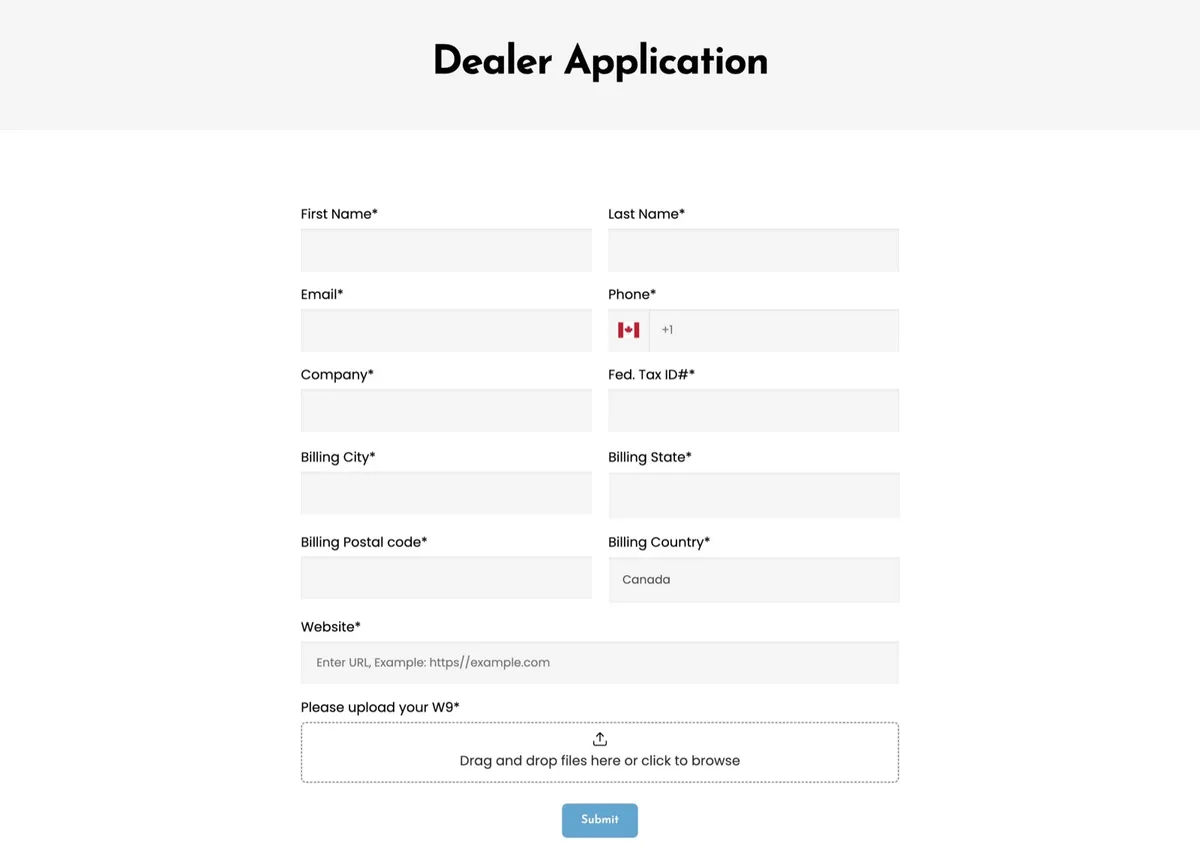
A real dealer application. Most ask for the same things: your company, your website and your tax ID. This one also wanted a W-9.
A dealer form means they’re actively taking on new dealers. If calling scares you, start with every brand on your list that has one.
2. A Short Email
Keep it short and professional. Send it from your own domain, not a free Gmail address. Cover four things:
- Who you are, and your store name.
- Your website link, so they can see the store.
- Which of their products you want to carry, and who you sell to.
- The question: are you open to another online retailer, and what’s your process?
3. A Phone Call
This is the fastest way to a real answer. My success rate is highest by phone.
My first supplier call was my first cold call ever. It was “pretty nerve-wracking.” But I had a script and I’d rehearsed it.
Here’s roughly how it went:
- The receptionist picks up. I ask for whoever handles their dealers.
- They put me through. I ask them to pull up my demo site.
- “Hey, I’m just curious if you guys are open to taking on another online retailer. You can take a look at my site. We specialize in [type of] equipment. We’re planning to launch on [date]. What’s your process for signing up?”
“They’re just people.” They have a whole network of dealers already. They’re used to this.
When I was still working full time, I couldn’t call during business hours. So I hired a contractor to make the calls. They landed my first few suppliers.
What Happens Next: A Real Approval, Start To Finish
First, the supplier sends questions. These are the questions one of my suppliers asked:
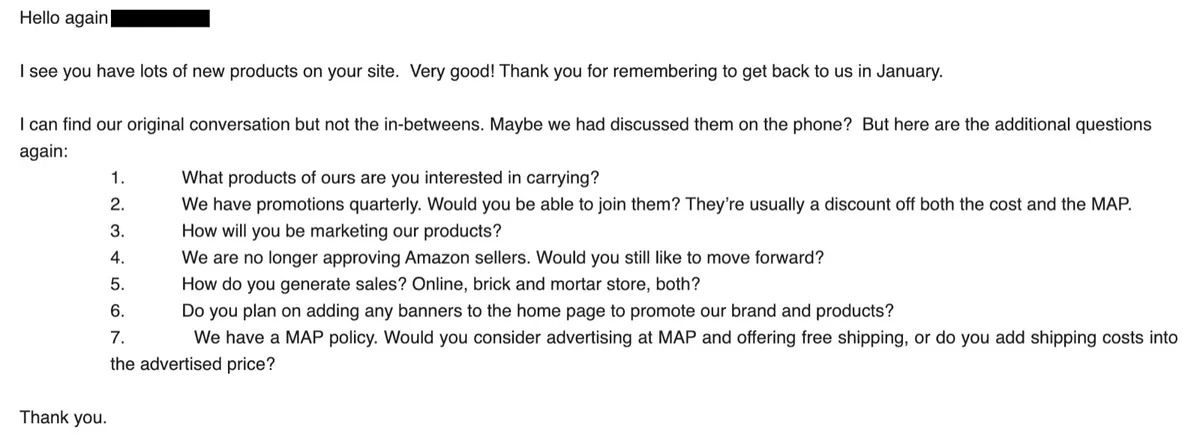
Their questions: what you’ll carry, how you’ll market it, no Amazon sellers, and their MAP policy.
Answer honestly. Your estimated sales, how you’ll handle shipping, and where you’ll advertise (Google Shopping, Bing, your website). On shipping, I say: “We’d like to use your freight accounts, and you bill us.”
Then the account forms:
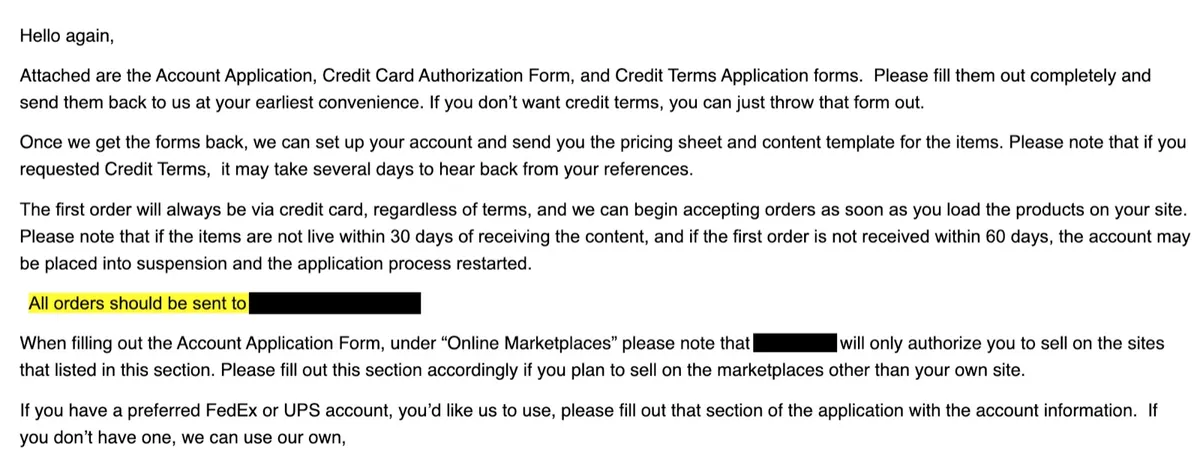
The account forms. This supplier’s first order is always by card, and the items must go live within 30 days.
Then the yes, with the price list and product content (the screenshot at the top of this page).
That’s a real start. Load their products, take the demo products off, and your store can take orders.
What Do Suppliers Check Before They Say Yes?
Manufacturers vet you. Here’s what they look at:
- That you’re a real business. A registered company, a tax ID, a resale certificate.
- Who you are and what your vision is.
- How and where you’ll advertise their products.
- That your website looks professional. A demo store with real categories, a phone number, an email and an address.
That last one matters most when you’re new. “If you come to them without a website or anything, it’s gonna be hard for them to take you seriously.”
Why Some Suppliers Say No
It happens. These are the reasons I’ve seen:
- A minimum opening order. Some want you to buy a set amount upfront.
- A sales track record. About 5% of the brands I contact want sales history first.
- Too many dealers already. They don’t want another store in the same space.
A no is often a “not yet.” One big brand told me to reach back out in about eight months. I did. She saw our track record and signed us.
The first few are the hardest, because you have no proof yet. After that it’s a domino effect. Now manufacturers call and email me, asking to be on my site.
Red Flags In High Ticket Dropshipping Suppliers
An easy approval doesn’t make a good supplier. These are the red flags in high ticket dropshipping suppliers that make me walk away:
- Under 20% margin. I need at least 20% between my dealer price and MAP. In my experience about 90% of manufacturers give that, so there’s no reason to settle.
- No MAP policy, or one nobody follows. If every store shows a different price on Google, you’ll end up in a price war.
- Products shipped from overseas. Long transit, quality issues and painful returns. That’s the low-ticket model I left.
- You have to hold stock. The whole point is that the manufacturer ships. I don’t hold inventory.
- Terms you can’t meet. Read the requirements. One of mine needed products live within 30 days and a first order within 60 days, or the account could be suspended.
- No help when something breaks. Ask what happens with freight damage and defects before you sign. The good ones make it right.
The full list of what to check in a dealer agreement is in my guide to starting.
How Do You Pay High-Ticket Dropshipping Suppliers?
Expect to start on card. One of my suppliers said it plainly: “The first order will always be via credit card, regardless of terms.”
The order flow is simple. Your customer pays you. You send the manufacturer a purchase order at your dealer price. They confirm with a pro forma invoice, an invoice or a sales order, then ship. You add the tracking to your order.
You can also apply for credit terms. That’s what the credit terms application in the screenshot above is for. They check your references first, which can take several days.
What I’d Do This Week
If I were starting over, here’s my week:
- Pick the niche first. Use the checklist from step 2 of the starting guide.
- Build the demo store. At least 5 categories, with a phone number, email and address.
- Run the competitor web. Aim for 20+ brands in a Google Sheet.
- Sort the list. Dealer form first, then email, then call.
- Contact as many as you can in one round. The first yes is the hardest.
All you need is one yes to build momentum. And the worst that can happen? They say no, and you’re right back where you are now.
My free high ticket dropshipping guide has the full chapter on getting manufacturers to say yes, plus how I pick a niche and my real numbers.
My exact call script, email templates and pitch deck will be in the Supplier Outreach Pack, an add-on when my high-ticket dropshipping course opens. Join the waitlist to hear first.
FAQ
How Many High Ticket Dropshipping Suppliers Do I Need To Start?
One yes is enough to launch. Load that brand's products, take the demo products off, and you have a real store. But don't stop there. Not every brand says yes, some sell better online than others, and margins differ. Carrying many brands also means you never depend on one supplier, and it lets you write comparison content later.
Will High Ticket Suppliers Work With A Brand-New Store?
Most will. In my experience only about 5% want to see a sales track record first. What they check is that you're a real business, who you are, and how you'll advertise their products. That's why you build a demo store before you contact anyone. If you show up with no website, it's hard for them to take you seriously. A no is often a not yet.
How Long Does Supplier Approval Take?
Dealer forms are usually the quickest route. A phone call gets you a real answer fastest. Some brands send questions first, then account forms, then the approval with a price list. If you ask for credit terms, it can take several more days while they check your references.
Are There Private Label High Ticket Dropshipping Suppliers?
I don't use any, so I can't vouch for them. Everything on my store is the manufacturer's own brand, at the manufacturer's price rules. That's the model in this guide. Buyers are already searching Google for those brands and model numbers, so you capture demand that already exists instead of building a new brand from scratch.
Do I Need A US Business To Get Approved By Suppliers?
You need a registered business. Dealer forms ask for your company name, a federal tax ID, your billing address and your website, and some want a W-9. You'll also want a resale certificate. I use a US LLC. I live in Canada and sell only into the US, so you don't have to live there. Some people sell to businesses in their own country with local suppliers too. The US is the biggest market, but it has more competitors.
Get My Free 60-Page Guide
The model, my real numbers, and how I pick a niche and get manufacturers to say yes.