High Ticket Dropshipping Google Ads: How I Actually Run Them

By Jako
Published November 13, 2026
In Short
- I run Google Shopping and Bing Shopping, not TikTok. Business buyers are already searching for the equipment, so ads capture demand instead of creating it.
- My Google Ads in 2025: $69.6K spent, 103K clicks, and Google reports a 3,104% return on ad spend. My Bing Ads, May to December 2025: $10,488 spent, $120,120 in tracked sales.
- Start at about $30 a day on Shopping, manual CPC, US only, with 100+ products live. Read your search terms in week one and add negative keywords.
- Work out your break-even ROAS before you judge anything. It depends on the margin. For my store it's usually about 4x (400%).
Contents
- The Ads I Run, At A Glance
- Do High Ticket Dropshipping Ads Even Work?
- How Do Google Ads And Google Shopping Work Together?
- What My Google Ads Account Looks Like After 12 Months
- What Is A Typical ROAS For High-Ticket Ecommerce?
- The Break-Even ROAS Math On A $5,000 Product
- Bing Ads And Microsoft Ads: Heavily Slept On
- Which Negative Keywords Save The Most Budget?
- What Is Google Merchant Center, In Plain English?
- What To Do In Your First 14 Days Of Ads
- High Ticket Ecommerce Advertising: The Numbers To Check
- Where My Numbers Come From
- What I’d Do This Week
- FAQ
High ticket dropshipping Google Ads are where most of my store’s paid sales come from. Not TikTok. Google and Bing Shopping.
In 2025 I spent $69.6K on Google Ads. Google reports a 3,104% return on that spend. Here’s the screenshot:
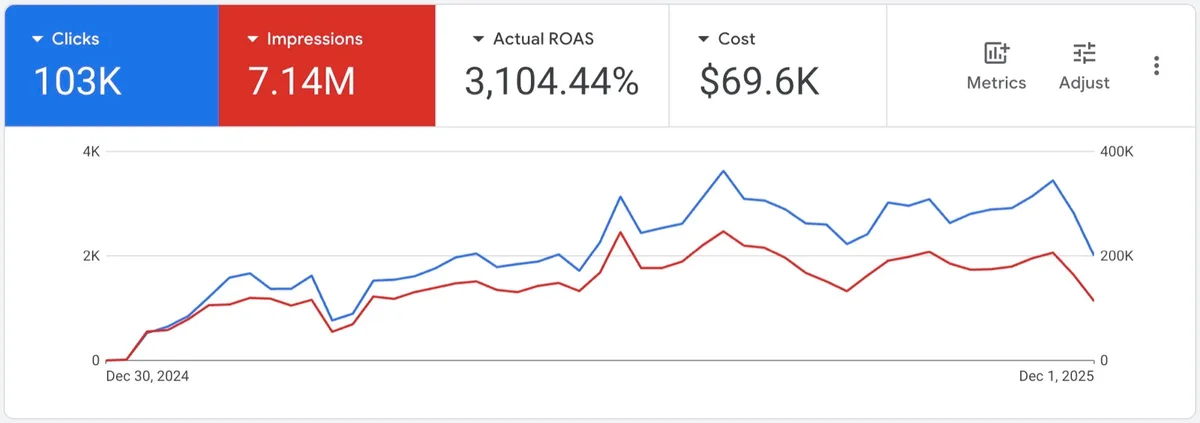
My Google Ads, December 30, 2024 to December 1, 2025. Google’s own “Actual ROAS” column.
This guide shows how I run them. Which campaigns, what budget, the break-even math, Bing, and my first 14 days. My store has done $3M+ in sales since January 2025, mostly to businesses. These are my results, not a promise of what you’ll make.
The Ads I Run, At A Glance
| Channel | What it does | Use it from |
|---|---|---|
| Google Shopping | Product ads with price and photo, for buyers searching now | Day one |
| Bing Shopping | The same buyers on work computers. Cheaper clicks | Day one |
| Google Search text ads | Text ads for best sellers and proven products. Clicks cost more | Once you have sales data |
| Meta (Facebook) | Retargeting only: product ads to people who visited | Once you have traffic |
The rule behind all of it: scrolling buyers are cold. Searching buyers are ready.
New to the model? Start with how to start high ticket dropshipping. This page is the deep dive on the ads step.
Do High Ticket Dropshipping Ads Even Work?
They work for me because of who’s searching.
Someone searching Google for a commercial dough mixer isn’t browsing for fun. Business buyers search for the brand and often the model number. They’re ready to buy.
So high ticket dropshipping ads aren’t about creating demand. They capture demand that’s already there. You just need to show up when they search.
Two more things make the math work:
- One sale pays for a lot of clicks. My average order is about $2,090. Many products sell for $5,000+.
- Business buyers don’t haggle much. They’re buying to a spec and a budget.
My first ad sale came a couple of hours after I turned ads on. It was on a product I didn’t think would sell. That click cost about 10 cents. I spent $30 that day and made about $1,200. That’s one day of my store, not a forecast.
How Do Google Ads And Google Shopping Work Together?
Google Shopping ads live inside Google Ads. You need two accounts, connected:
- Google Merchant Center holds your product feed: titles, prices, photos, stock. Shopify sends it there.
- Google Ads is where you build the Shopping campaign, set the budget and the bids.
When someone searches, Google matches the search to products in your feed and shows the ad with the photo and price. You pay when they click.
That’s why Shopping suits high-ticket stores. The buyer sees the price before they click. Nobody clicks a $6,000 ad by accident.
My Campaign Setup, In One Paragraph
I use three-tiered Shopping campaigns: high, medium and low priority, with single product ad groups. It lets me decide what I pay for broad searches and what I pay for very specific ones. I start with manual CPC, US only. I don’t run Google text ads at the start, because the clicks cost more. Those come later, for best sellers and proven converters. No Performance Max.
I started at $30 a day. Today the account runs at about $150 a day.
The full build, step by step, is in my course. This page gives you the idea and the numbers.
What My Google Ads Account Looks Like After 12 Months
The screenshot at the top covers almost all of 2025. The numbers:
- 103K clicks from 7.14M impressions.
- $69.6K spent. That’s about 68 cents a click on average (my calculation from the screenshot).
- 3,104% actual ROAS. By Google’s count, about $31 in tracked sales for every $1 spent.
One caution on that last number. Ad platforms count sales their own way. Google’s tracked sales won’t match Shopify exactly, and they can count a sale another channel also helped. I use ROAS to compare campaigns inside one account, not as my profit.
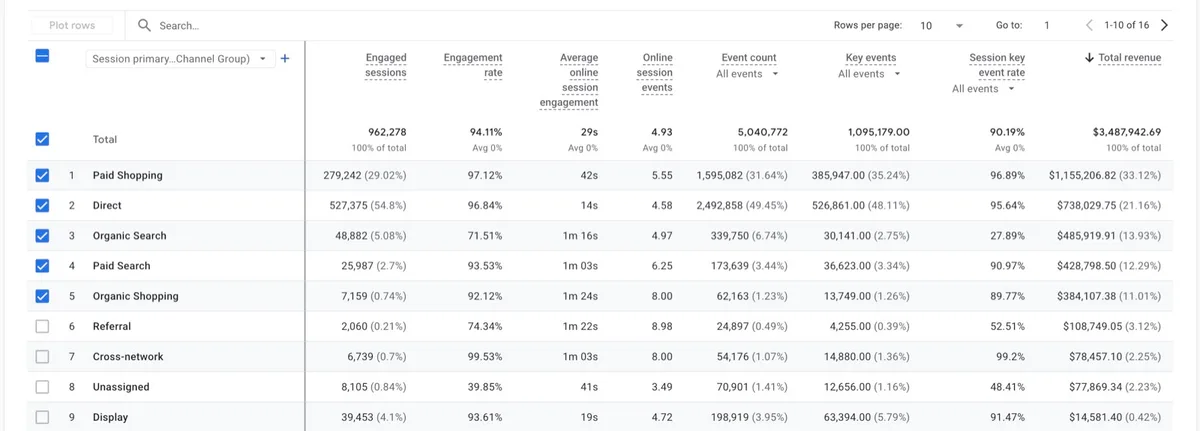
Here’s where my revenue comes from in Google Analytics, from January 2025:
| Channel (Google Analytics) | Share of revenue |
|---|---|
| Paid Shopping | 33% |
| Direct | 21% |
| Organic Search | 14% |
| Paid Search | 12% |
| Organic Shopping | 11% |
From the start of January 2025. Google Analytics counts differently from Shopify, so I only use the shares.
Paid Shopping is the biggest single channel. Add Paid Search and about 45% of the store’s revenue in Google Analytics comes from paid ads.
What Is A Typical ROAS For High-Ticket Ecommerce?
I can’t give you a typical ROAS for high-ticket ecommerce that I’d trust. I haven’t seen a sourced benchmark, and every store’s margin is different. What I can give you is the only number that matters for your store: break-even ROAS.
My two accounts, for reference:
| Account | Spend | ROAS reported |
|---|---|---|
| Google Ads (Dec 30 2024 to Dec 1 2025) | $69.6K | 3,104% |
| Bing Ads (May to Dec 2025) | $10,488 | 1,145% |
Both are my store’s numbers, not a target. They’re well above my break-even, which is usually about 4x (400%).
The Break-Even ROAS Math On A $5,000 Product
Break-even ROAS is the point where a product’s ads cost exactly what the sale leaves you. Below it, you lose money on that product. Above it, you keep the difference.
Here’s my one-product example:
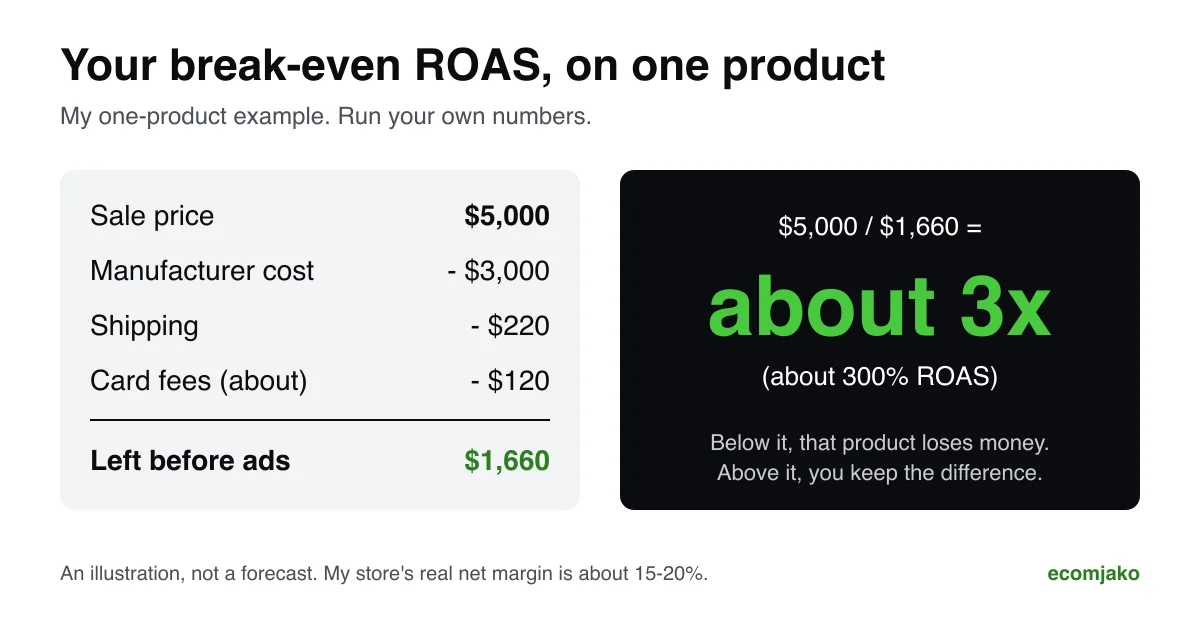
- Sale price: $5,000.
- Minus my cost from the manufacturer: $3,000.
- Minus shipping: $220. I pay for shipping. It’s not free from the supplier.
- Minus card fees: about $120.
- Left before ads: $1,660.
Break-even ROAS = $5,000 / $1,660 = about 3x, or 300%.
In my example, ads for that sale were $30. That leaves about $1,630. It’s an illustration from one product, not a forecast. My store’s real net margin is about 15-20%.
Across my store, break-even depends on each manufacturer’s margin. About 4x (400%) is usually break-even for me. So 3x on this product is the friendly case, not the norm.
Do this math for your own products before you judge a campaign. A lower-margin product needs a higher ROAS to break even.
Bing Ads And Microsoft Ads: Heavily Slept On
A lot of business buyers work on company computers. Microsoft computers, with the Edge browser. And Edge defaults to Bing. So a lot of my audience searches on Bing, not Google.
Fewer stores advertise there. So the clicks are usually cheaper, for the same kind of buyer.
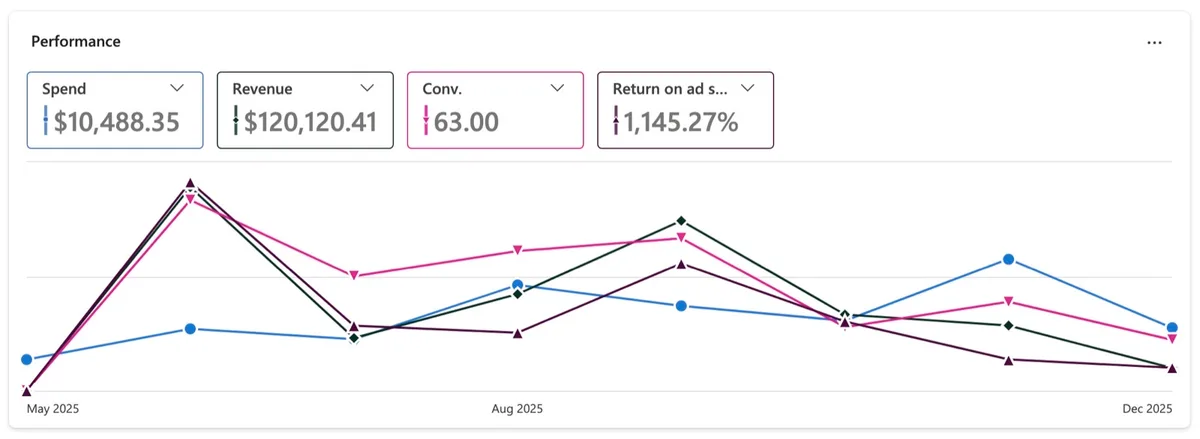
My Bing Ads, May to December 2025.
- $10,488 spent, $120,120 in tracked sales.
- 63 conversions. That’s about $166 in ad spend per order, and about $1,907 per order in sales (my calculation from the screenshot).
Ignoring Bing is a mistake I see a lot. In a lot of industries, business buyers still use it, and in my experience it converts well.
Which Negative Keywords Save The Most Budget?
A negative keyword is a search you tell Google not to show your ads for.
In week one, read the search terms report. It shows the real searches your ads appeared for. I check two things: is this someone who’d buy, and did they land on the right product?
I block a lot. The usual groups are people who were never going to buy:
- Job seekers. Searches about jobs and careers.
- Students. Searches for school and course material.
- Researchers. People reading up, not buying.
- DIY. People trying to make or fix it themselves.
Just as important is what you never block. In high-ticket B2B, words that look like bargain hunting are often buyers. Quote, price, wholesale, commercial and specs stay in. Some of my biggest orders started as quote requests.
Not watching for keyword leakage is a classic way to spend a budget with nothing to show for it.
What Is Google Merchant Center, In Plain English?
Merchant Center is Google’s product catalogue for your store. Your Shopping ads pull from it.
And Google is very strict about it. My account got suspended for “misrepresentation”, the most common one. It was something small: details that didn’t match across the site.
Two things to get right before your first ad runs:
- Your Merchant Center account, your store and every page on it say the same, accurate thing. Business hours, return policy, no typos.
- No trademark names or ® or ™ symbols in your product titles.
I’ll cover the suspension and how I fixed mine in its own guide.
What To Do In Your First 14 Days Of Ads
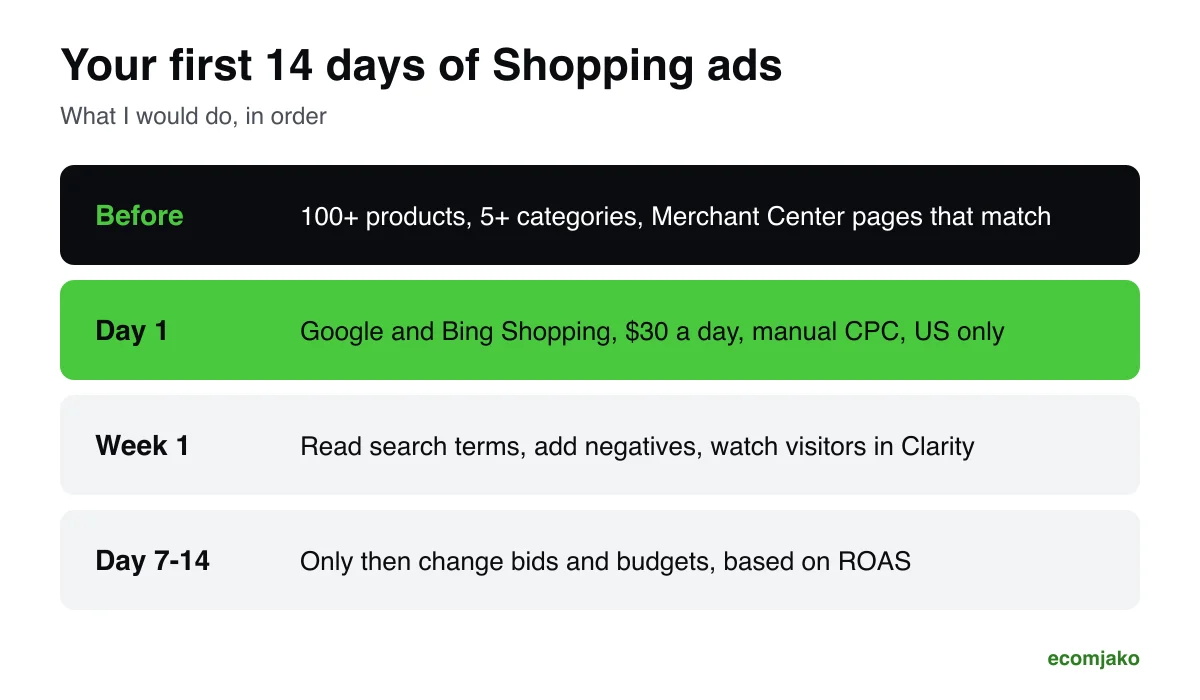
- Before. At least 100 products and 5 categories live. A visitor who clicks around should see a real store, not a one-product site. Merchant Center pages match.
- Day one. Google and Bing Shopping at about $30 a day, manual CPC, US only. $15 a day works when you only have a few products.
- Week one. Search terms and negatives. Watch visitors in Microsoft Clarity: are they hovering on the price, hitting broken pages, struggling on mobile?
- Days 7 to 14. Leave bids and budgets alone until then. A week of data on $1,000+ products is too little to judge. Then change what the numbers tell you.
High Ticket Ecommerce Advertising: The Numbers To Check
Once ads are running, high ticket ecommerce advertising comes down to a few numbers:
- Search terms. New negatives, and searches that deserve more budget.
- Clicks and cost. Is a product eating budget with no orders?
- Conversions. Which products and campaigns bring orders.
- ROAS against break-even. Is each campaign above the line?
The common mistakes: bidding too low, and a budget too small to get data. Targeting the wrong keywords. Handing control to the automated settings too early.
Where My Numbers Come From
Every figure on this page is from my own store:
- Google Ads: account screenshot, December 30, 2024 to December 1, 2025.
- Bing Ads: account screenshot, May to December 2025.
- Revenue by channel: Google Analytics, from January 2025.
- $3M+ in sales since January 2025 and the $2,090 average order: Shopify.
- Budgets and break-even: my own account settings.
- The $5,000 example: an illustration from one product. The first ad day: one day of my store. Neither is a forecast.
I keep my niche private. These are my results, not a promise of what you’ll make.
What I’d Do This Week
If you’re about to turn on ads:
- Work out break-even ROAS for your 10 most important products.
- Check Merchant Center against every page of your store. Same hours, same policies.
- Set up Google and Bing Shopping at about $30 a day, manual CPC, US only.
- Start a negative keyword list before day one, then read search terms daily.
Still picking what to sell? Here’s how I choose high ticket dropshipping products with enough margin to advertise, and how I get approved by high ticket dropshipping suppliers. More guides are on the blog.
My free 60-page high ticket dropshipping guide has the full chapter on where my buyers come from. When you’re ready to build, my high-ticket dropshipping course covers the rest. The full three-tier campaign, the feed and my Merchant Center checklist, step by step.
FAQ
Is Google Ads For High Ticket Dropshipping Worth It?
For my store, yes. In 2025 I spent $69.6K on Google Ads and Google reports a 3,104% return on that spend. Google Shopping ads bring in about a third of my store's revenue, the biggest single channel in my Google Analytics. It works because business buyers search for the exact equipment they need, and one order can be thousands of dollars. Those are my results, not a promise of yours. Your margin and your products decide whether it works for you.
How Much Should I Spend On Google Ads When I Start?
I recommend about $30 a day on Google Shopping in the US, across your whole store. That's what I started with. You can start at $15 a day when you only have a few products, because the budget is spread across fewer of them. I wouldn't go below about $10 a day. Have at least 100 products and 5 categories live first, so the store looks real when someone clicks.
What Is The Best Bid Strategy For Google Ads When You Start?
I start with manual CPC. That means I set what I'll pay per click, not Google. A new account has no sales data, so the automated strategies have nothing to learn from yet. Manual bids keep you in control while you learn which products and searches turn into orders. Bidding too low is a common mistake, though. With $1,000+ products, one sale covers a lot of clicks.
Should I Use Performance Max For High Ticket Dropshipping?
No. I don't run Performance Max. The biggest Google Ads mistake I see is turning on every AI feature. You lose control over which searches you pay for, and the campaign stops being set up the way it should be. I keep a lot of control on my end with standard Shopping campaigns, plus Search text ads for products that already sell.
Should I Run Facebook Ads Or Google Ads For High Ticket Products?
Google and Bing first. Someone scrolling Facebook isn't shopping for a commercial fryer. Someone searching Google for one is. I only use Meta for retargeting: product ads shown to people who already visited my store and didn't buy. That reminds warm buyers instead of trying to create demand from cold ones.
Get My Free 60-Page Guide
The model, my real numbers, and how I pick a niche and get manufacturers to say yes.