Is High Ticket Dropshipping Worth It? My Honest Answer After $3M+ In Sales

By Jako
Published November 17, 2026
In Short
- Yes, high ticket dropshipping is worth it if you'll spend about a month building before the first sale. My store has done $3M+ in sales since January 2025 and nets about 15-20%. That's my store, not a promise of yours.
- In my one-product example, about $1,630 of a $5,000 sale is left after the manufacturer, shipping, card fees and ads. You need far fewer orders than with $20 products.
- It costs about $200 to start, plus $15 to $30 a day in ads once your products are live. No inventory.
- It's not worth it if you want fast money, hate talking to suppliers or customers, or won't give it at least an hour a day.
Contents
- Worth It For You, Or Not?
- One Sale, Line By Line
- What It Costs To Find Out If It Works
- Is High Ticket Dropshipping Profitable?
- Is High Ticket Dropshipping Worth It In 2026?
- High Ticket Dropshipping Profit Margins, Per Sale And Per Year
- High Ticket Dropshipping Pros And Cons
- Should I Consider High Ticket Dropshipping? Three Questions
- What Is The High Ticket Dropshipping Success Rate?
- Does High Ticket Dropshipping Work, And Is It Legit?
- Profitable High Ticket Dropshipping Niches 2026: Where To Look
- What Happens After Your Store Goes Live?
- When It Is Not Worth It
- What I’d Do If I Were Deciding Today
- Where My Numbers Come From
- FAQ
Is high ticket dropshipping worth it? For me, yes. It changed my life. But it’s not for everyone, and the people who sell courses rarely tell you who should skip it.
My store has done $3M+ in sales since January 2025, mostly to businesses, with an average order of about $2,090. Below, I break down where the money goes on one product. Then what it costs to test, and when I’d walk away.
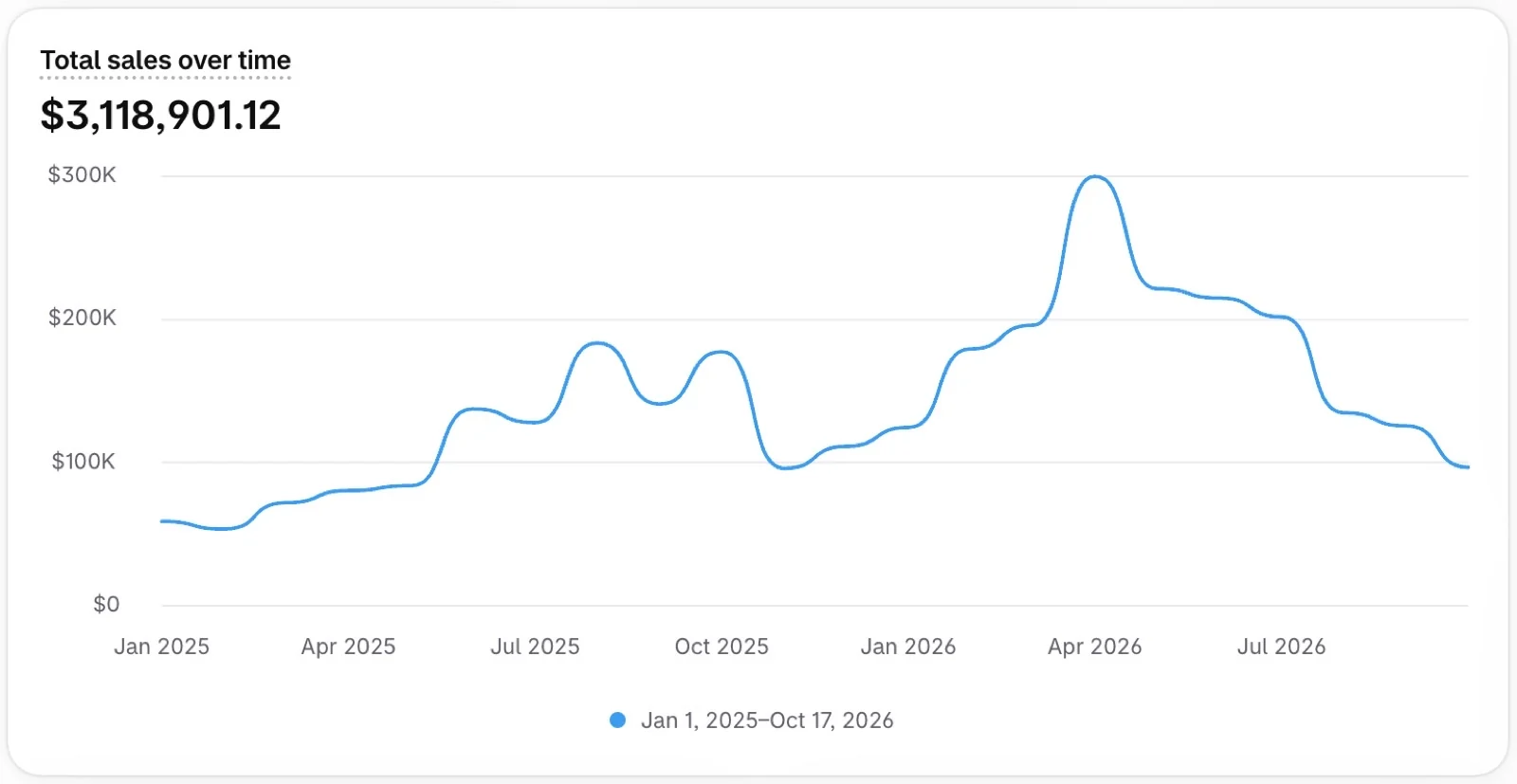
My Shopify dashboard. I keep my niche private. These are my results, not a promise of yours.
Worth It For You, Or Not?
Here’s the short version before the numbers.
It’s worth it if you:
- Can give it at least an hour a day for about a month before the first sale.
- Are fine with phone calls and emails to suppliers and business buyers.
- Want a real business that sells to companies, not a trend that dies in six weeks.
- Can afford about $200 to start plus $15 to $30 a day in ads.
It’s not worth it if you:
- Want fast money, or you’re always chasing the next hot thing.
- Won’t follow a checklist when Google reviews your store’s details.
- Need money from it next week.
One Sale, Line By Line
The best way to judge high ticket dropshipping is one sale, start to finish. Here’s my one-product example.
| Line | Amount | Note |
|---|---|---|
| Sale price | $5,000 | Paid on my site |
| Supplier | - $3,000 | My dealer price |
| Shipping | - $220 | Freight, I pay it |
| Card fees | - $120 | About 2.4% |
| Ads | - $30 | One day |
| Left | about $1,630 | Before other costs |
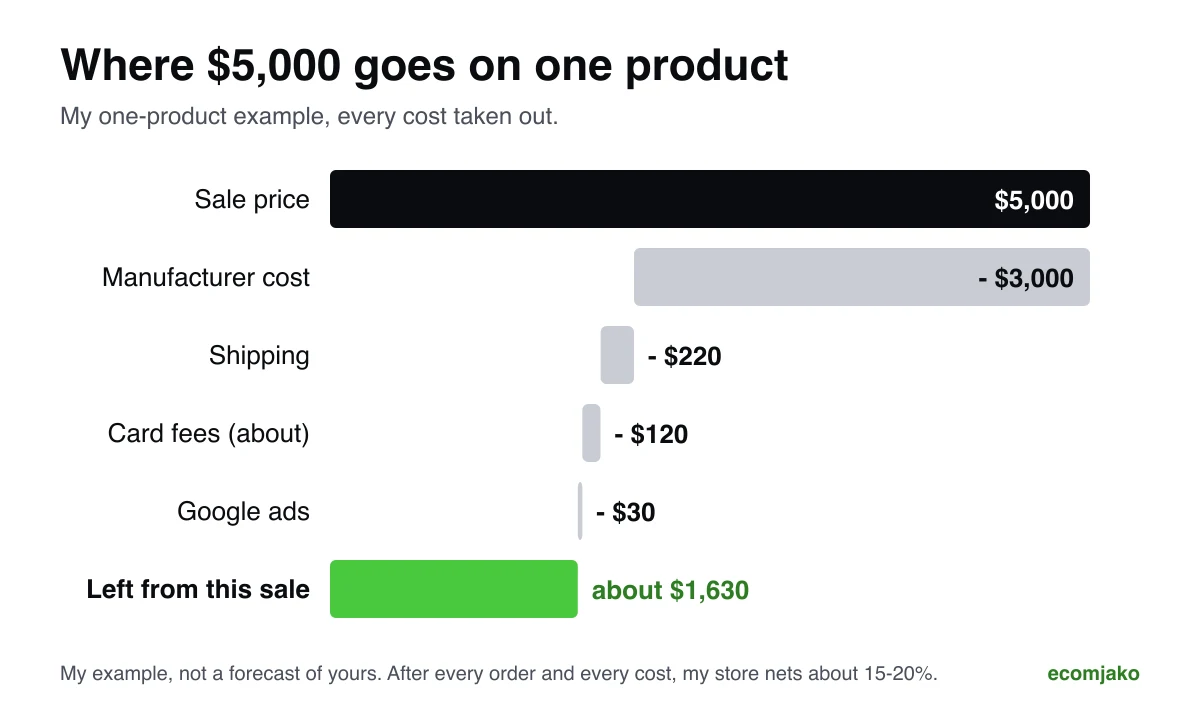
My one-product example. Free to use with a link to this page.
Not every sale looks like this. Some products leave less, some leave more. Some manufacturers give me up to a 60% margin. After every sale and every cost, my store nets about 15-20%.
That’s the whole case in one line. One of my orders can leave hundreds or thousands of dollars. A $20 phone case leaves about $6.
What It Costs To Find Out If It Works
High ticket dropshipping is cheap to test, because you never buy stock. The manufacturer ships each order from its own warehouse after you’ve been paid.
Here’s what I’d budget to get to a first order:
- LLC: about $100 to $150.
- Resale certificate: free.
- Shopify: a short free trial, then $1 a month for the first 3 months on a monthly plan. Check the current offer.
- Domain: about $10 to $20 a year.
- Google Workspace email: about $7 a month.
- Toll-free number: about $20 a month.
- Logo: about $20, or free with AI.
That’s around $200 to start. Then ads: I started at $30 a day on Google Shopping, and $15 a day works when you have fewer products. My full cost list is in how to start high ticket dropshipping step by step.
The real cost is time. Plan on about a month at an hour or two a day to go from niche to ads running.
Is High Ticket Dropshipping Profitable?
It is for my store. Mine nets about 15-20% after ads, shipping and fees. On $3M+ in sales, that’s a real business. It’s my store’s margin, not a promise of yours.
Two things make it work. First, each order is big. My average is about $2,090, and many products sell at $5,000 or more. Second, the buyers are businesses. About 40% of my orders, and 59% of my sales, are billed to a company. They buy to spec and they rarely haggle.
When I look at a new niche, I want three numbers to line up. Products average $1,000 or more. The margin is at least 20% before ads. And people already search for the niche.
Is High Ticket Dropshipping Profitable In 2025?
2025 was my store’s first full year on this model. In 2025, my Google Ads cost $69.6K and Google reported a 3,104% return on that spend. That’s Google’s own number, not my profit.
Is High Ticket Dropshipping Worth It In 2026?
So, is high ticket dropshipping still profitable 2026 and beyond? For my store, yes, and the reasons haven’t changed.
Businesses still buy equipment online. They search Google and Bing like anyone else. They need commercial-grade gear, so there’s no cheap version for them to switch to. My store did $1.78M+ in sales in 2026 up to mid-October.
What has changed is the advice online. A lot of it pushes AI shortcuts and trending products. Those come and go. So is high ticket dropshipping worth it in 2026? For a real store selling what businesses already search for, I’d say yes. For a store built to chase a trend, no.
High Ticket Dropshipping Profit Margins, Per Sale And Per Year
There are two margins, and people mix them up.
The margin on one product. This is the gap between your dealer price and the price you list at, usually 20% or more. In my example, $3,000 against $5,000 is a 40% gap. Below 20%, ads get hard.
The margin on the whole store. This is what’s left after a year of ads, shipping, fees, returns and tools. Mine is about 15-20%. The yearly number is always lower than the best single sale.
What One Sale Can Leave: Three Examples From My Store
- My first business order on this store: $3,500, with no ads. It came in while I was still uploading products. I kept about $1,500 on it, because it was a high-margin brand.
- A $5,000 product at a 20% margin: about $1,000 before costs. When I was landscaping, that was almost a full paycheck from one order.
- My one-product example above: about $1,630 left from a $5,000 sale, after every cost of that sale.
These are my sales, not a promise of yours. A few brands give more, up to a 60% margin.
Ads are the cost that decides the second number. For me, about 4x return on ad spend is usually break-even. The full math is in my Google Ads breakdown for $5,000 products.
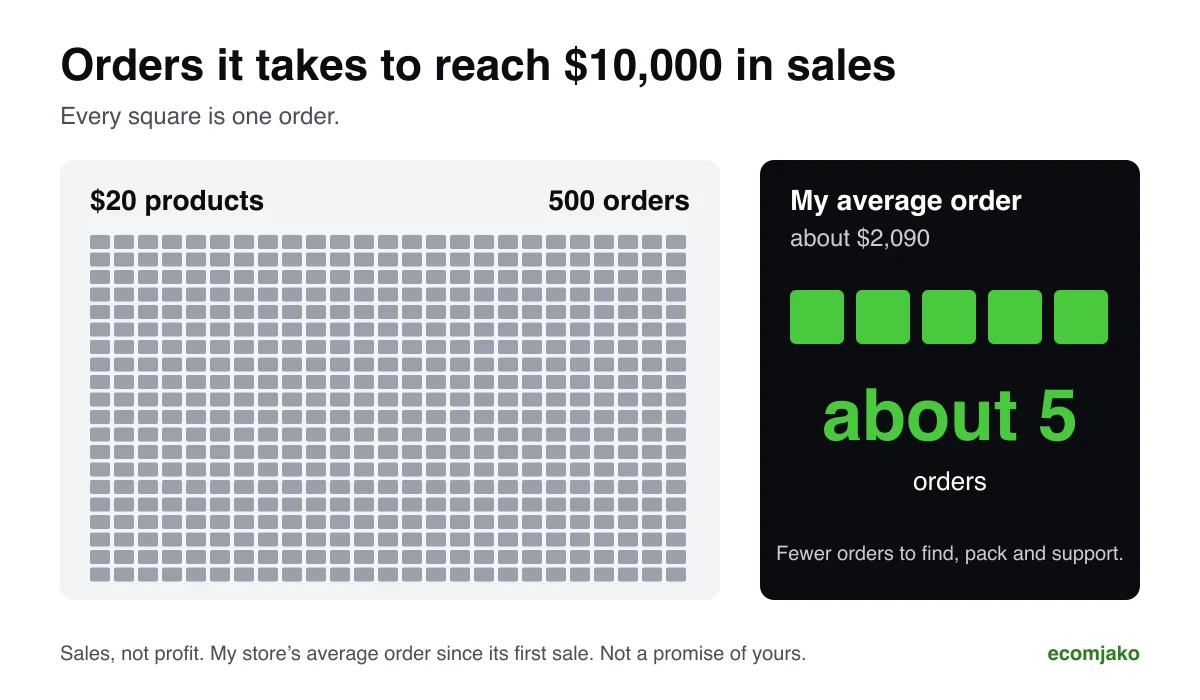
Fewer, bigger orders. Sales, not profit.
High Ticket Dropshipping Pros And Cons
Here’s the honest list.
Pros:
- Big orders. About 5 orders at my average reaches $10,000 in sales. With $20 products, that’s 500.
- No inventory. You don’t buy stock or rent a warehouse. I can travel and the business still runs.
- Business buyers. They buy to spec, often order several units, and pay by card or on purchase orders.
- Protected prices. Brands in a good niche set a minimum advertised price, so nobody undercuts you on the front end.
- Evergreen products. Businesses need the same equipment every year.
Cons:
- Slower start. You need suppliers, a store and about 100 products before ads.
- Some suppliers say no. In my first round, about 10 of 15 said yes. Some want a minimum order or sales history.
- Freight goes wrong sometimes. A carrier once dropped a package. The manufacturer shipped a new unit free, but it happens.
- Returns cost more. A wrong product on a $3,000 order means real return freight. Most stores charge a restocking fee for this reason.
- Google is strict. I had a Merchant Center suspension for small mismatches across my site and fixed it with a checklist.
Want products that fit the pros? My guide to profitable high ticket dropshipping products lists eight with price ranges.
Should I Consider High Ticket Dropshipping? Three Questions
Ask yourself three questions. If you answer yes to all three, I’d say you should get into high ticket dropshipping.
- Will you give it an hour a day for a month? That’s the minimum. I built my first store around a full-time job.
- Will you pick up the phone? You’ll call suppliers, and some business buyers call you. They’re warm, not cold. My first supplier call was my first cold call ever.
- Will you follow the boring steps? The LLC, the resale certificate, the demo store, the product specs. The boring parts are why it works.
You don’t need industry experience either. Your store doesn’t have to relate to your current work.
What Is The High Ticket Dropshipping Success Rate?
Nobody publishes a real high ticket dropshipping success rate. I looked. There are no reliable statistics on how many stores make it, and any percentage you see in an ad is a guess.
Here’s what decides it, from my own store and my failures before it:
- The niche. A niche that fails one test costs you months. My first store sold lawn equipment. The niche wasn’t great and the returns weren’t worth it, so I sold that store and moved on.
- The ads. Bad ad settings can burn a budget in a week. I don’t use Performance Max.
- Staying with it. Before this worked, I spent about $25,000 on courses. Trading, Etsy, Amazon, low-ticket dropshipping and two high ticket programs. Most of them were a waste. I didn’t quit.
Does High Ticket Dropshipping Work, And Is It Legit?
Yes, it’s legit. It’s the same model as a big hardware store carrying brands it doesn’t own, just online. I’m an authorized online retailer. Manufacturers approve me, give me dealer pricing, and ship my orders from their warehouse.
It sounds scammy at first because people assume you need 25 years in business or a showroom to sell $5,000 equipment. You don’t. Several of my manufacturers only sell through retailers. Fortune 500 companies and the federal government have bought from my store.
Can You Dropship Expensive Items?
Yes, you can dropship expensive items, and businesses buy them online every day. One of my biggest orders was $99,106.77, for a contractor’s project. It started as a quote.
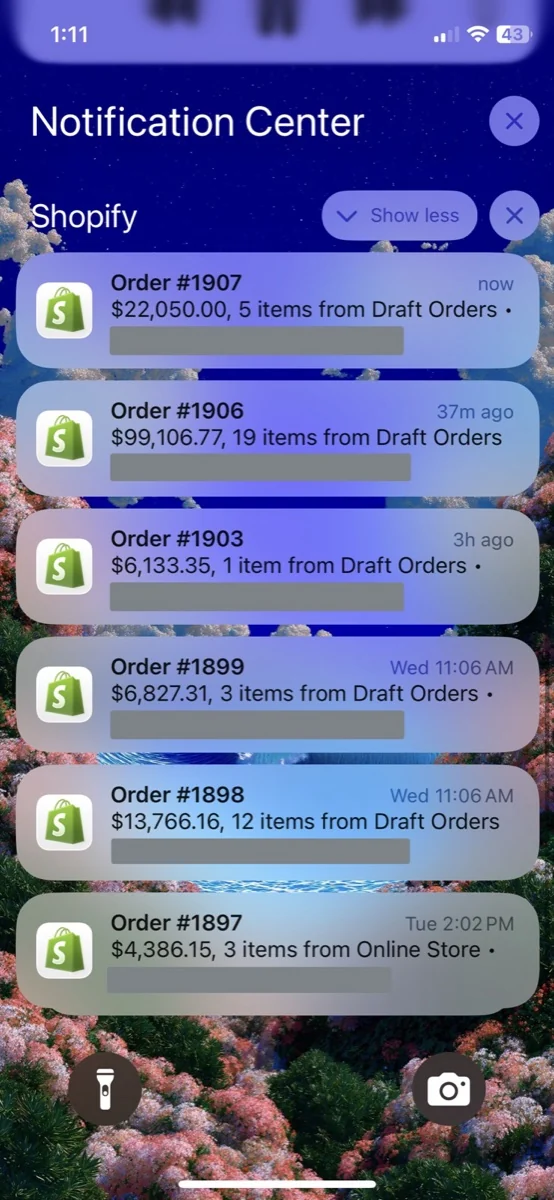
Two orders from one day in April 2026. My results, not a promise of yours.
Profitable High Ticket Dropshipping Niches 2026: Where To Look
People search “high ticket dropshipping niches 2026 profitable” hoping for a list. A list won’t help you. The best niches are boring equipment that businesses need, and they pass the same tests every year.
My public example is restaurant equipment. Commercial dishwashers, ovens and prep tables are needs, not wants, and the brands protect their prices. My seven-test niche scorecard scores it with real search numbers.
I’d skip the niches most gurus teach. Saunas, cold plunges, pellet grills, pizza ovens, fireplaces, wine coolers and e-bikes.
What Happens After Your Store Goes Live?
The work doesn’t stop at launch. It changes. Here’s what I do once products are live.
- Week one: I check the Google Ads search terms every day. I block the ones that don’t fit, like jobs, students and DIY searches. I also watch real visitors in Microsoft Clarity, a free tool, to find broken pages and confusing spots.
- Google and Bing Shopping: my main traffic. I run a three-tier Shopping setup and add Search ads for my best sellers. Bing is cheaper and heavily slept on.
- Retargeting: I use Meta only to show products to people who already visited and didn’t buy.
- SEO: product and category pages that rank on their own. In my store’s Google Analytics, organic search brought in about 14% of sales.
- Email: if sales are slow, my checklist adds a sign-up with a first-order coupon and an abandoned-cart email.
The full setup, with my real numbers, is in how I run Google Ads on $5,000 products.
When It Is Not Worth It
High ticket dropshipping is not worth it in four cases.
- You need income this month. Plan for about a month of building, then weeks of testing.
- You want to avoid people. Suppliers want to know you’re real, and buyers ask about specs and shipping.
- You’d sell products in the $300 to $1,000 range. That’s the danger zone, and my products guide explains why.
- You won’t fix problems. Something will break: a wrong order, a supplier mistake, an ads setting. Each one has a fix if you look for it.
What I’d Do If I Were Deciding Today
I’d spend one week on the niche before I spent a dollar. Pick 3 to 5 ideas and run each through the same tests. If none passes, you’ve lost a week, not $2,000.
If one passes, I’d follow my step-by-step guide to starting. It goes from business setup to the demo store, the first supplier, then products and ads.
My free high ticket dropshipping guide has the whole process in one place, including my niche checklist.
Where My Numbers Come From
- Sales, orders, average order and company billing: my Shopify store, to October 2026.
- Google Ads cost and ROAS for 2025: my Google Ads account (Google’s “actual ROAS” column).
- Net margin of about 15-20%: my own figure, not a Shopify report.
- The $5,000 product: my worked example for one product, with card fees at about 2.4% plus 30 cents.
FAQ
Can I Make $10,000 A Month Dropshipping?
Nobody can promise you $10,000 a month, and sales aren't profit. At my store's average order of about $2,090, $10,000 in sales is about 5 orders a month. At my 15-20% net margin, $10,000 in sales leaves about $1,500 to $2,000. Keeping $10,000 a month would take roughly $50,000 to $67,000 in sales. That's my store's math, not a promise of yours.
Why Do So Many Dropshippers Fail?
In my experience, most dropshippers fail because they chase trending $20 products with thin margins, then quit when the trend dies. Each sale leaves a few dollars, so ads eat the profit. Others pick a niche nobody searches for, skip the boring setup, or stop at the first problem. I failed at Etsy, low-ticket dropshipping and Amazon FBA before this model worked. What changed was selling things businesses already search for, at prices that leave room for ads.
Is High Ticket Sales Worth It?
High ticket sales is a different job from high ticket dropshipping. High ticket sales usually means closing calls for someone else's coaching or software, paid by commission. High ticket dropshipping means you own an online store that sells $1,000+ products from manufacturers, who ship them for you. I've only done the second. Many of my buyers order straight from the website, with no call at all.
How Long Does High Ticket Dropshipping Take To Pay Off?
High ticket dropshipping takes about a month to build before ads go live: about a week for the niche, a day for the demo store, up to a week for paperwork and suppliers, and about a week of product uploads. My first sale from ads came a couple of hours after I turned them on. That's one day of mine, not a promise. Plan for weeks of testing before a store pays for itself.
Get My Free 60-Page Guide
The model, my real numbers, and how I pick a niche and get manufacturers to say yes.