High Ticket Dropshipping Niches: How I Score One Before I Spend A Dollar

By Jako
Published November 15, 2026
In Short
- The best high ticket dropshipping niches pass 7 tests: $1,000+ main products, a need not a want, about 40,000 US searches a month across the store, 20+ manufacturers, MAP pricing, 20%+ margin and 4 to 15 competitors. Repeat orders are a bonus.
- Pick the customer, not the product. A niche is everything one kind of business needs, so the store can go deep, not wide.
- Restaurant equipment, scored with real search numbers: 14 commercial categories add up to 48,500 US searches a month. It passes the 40,000 test.
- Skip residential appliances, custom-made items, restricted products and the niches every guru teaches, like saunas, pellet grills, e-bikes and wine coolers.
Contents
- The Scorecard At A Glance
- How To Choose A High Ticket Dropshipping Niche: My 7 Tests
- Restaurant Equipment, Scored Live
- What Are The Best High Ticket Dropshipping Niches?
- Go Deep, Not Wide
- High Ticket Dropshipping Ideas I’d Look At Today
- The Niches That Will Waste Your Time
- How Do You Find Dropshipping Niches With Low Competition?
- Do You Need Experience In Your Niche?
- How Long Should Picking A Niche Take?
- What Happens After You Pick A Niche?
- Your Niche Shortlist This Week
- FAQ
The best high ticket dropshipping niches aren’t secret. They’re boring. They sell $1,000+ equipment to businesses that need it, and they pass a short list of tests before you build anything.
I picked my own niche with these tests. My store has done $3M+ in sales since January 2025, mostly to businesses, with an average order of about $2,090.
This guide gives you my 7-test scorecard, a restaurant equipment niche scored with real search numbers, the high ticket dropshipping ideas I’d look at today, and the niches I’d never touch.
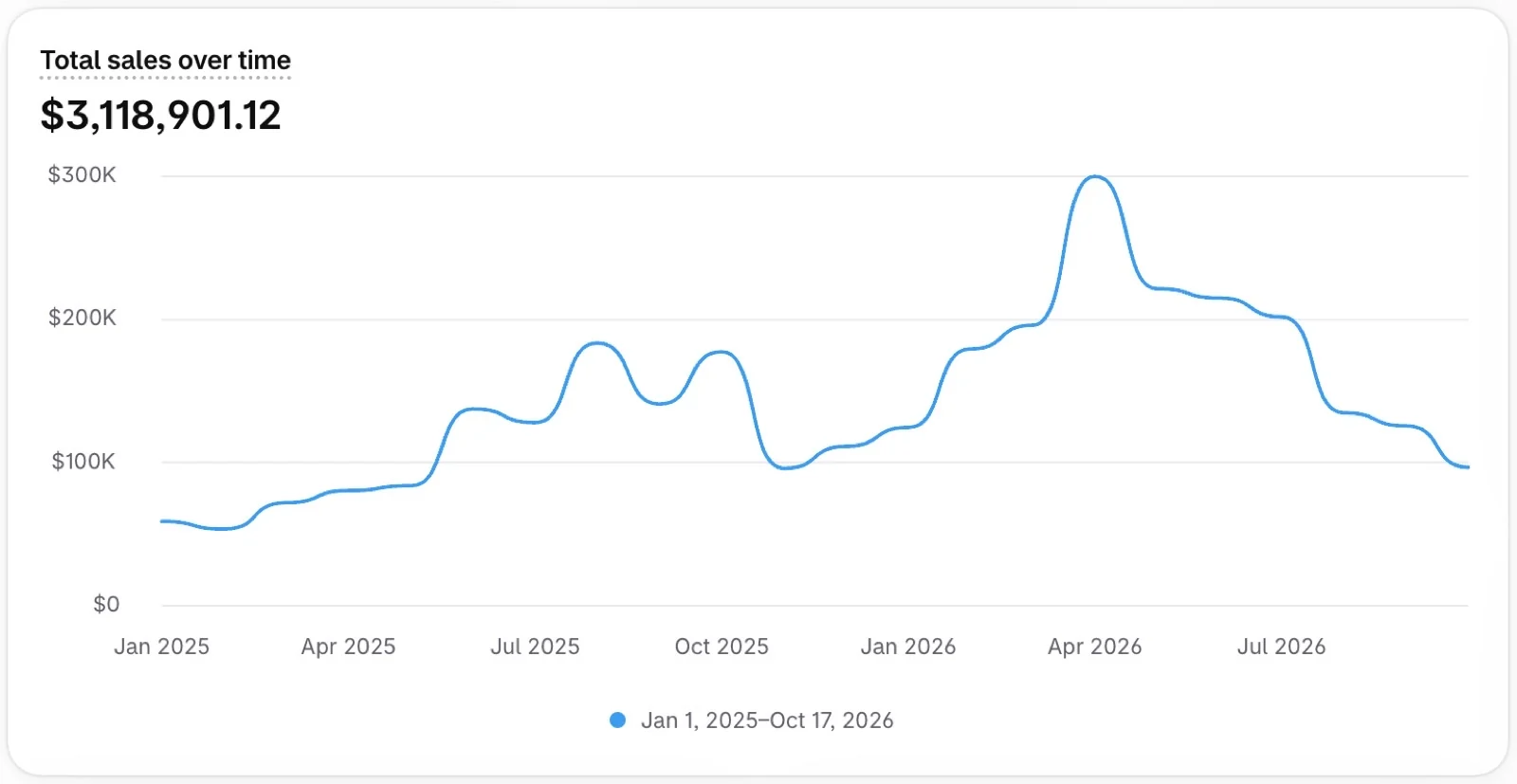
My Shopify dashboard. I keep my niche private. These are my results, not a promise of yours.
The Scorecard At A Glance
Here’s the whole scorecard. A niche has to pass all 7 tests. The bonus is a big green flag. The numbers are for the US.
| Test | Pass mark | Fails when |
|---|---|---|
| 1. Price | Main products average $1,000+ | Most products sit at $300 to $1,000 |
| 2. Need | Businesses can’t put it off | It’s a luxury or a “nice to have” |
| 3. Demand | About 40,000 US searches a month, all categories added up | One product with a few thousand searches |
| 4. Manufacturers | 20+ that dropship | You’d rely on one or two |
| 5. Price protection | MAP or MSRP, 500+ searches a month per brand | Every store shows a different price |
| 6. Margin | At least 20% | Under 20%, ads get hard |
| 7. Competition | 4 to 15 direct competitors | Zero, or 15+ strong sites |
| Bonus | Repeat orders | One-time purchase, nothing after |
Selling in the UK, Canada or Australia? Halve the searches (about 20,000) and the manufacturers (10+). Look for about 5 competitors, and no more than 7 to 10.
How To Choose A High Ticket Dropshipping Niche: My 7 Tests
I picked my niche by process of elimination. It was up against a few others. I ran them all through the same tests, and one had the most lucrative opportunity and a gap in the market.
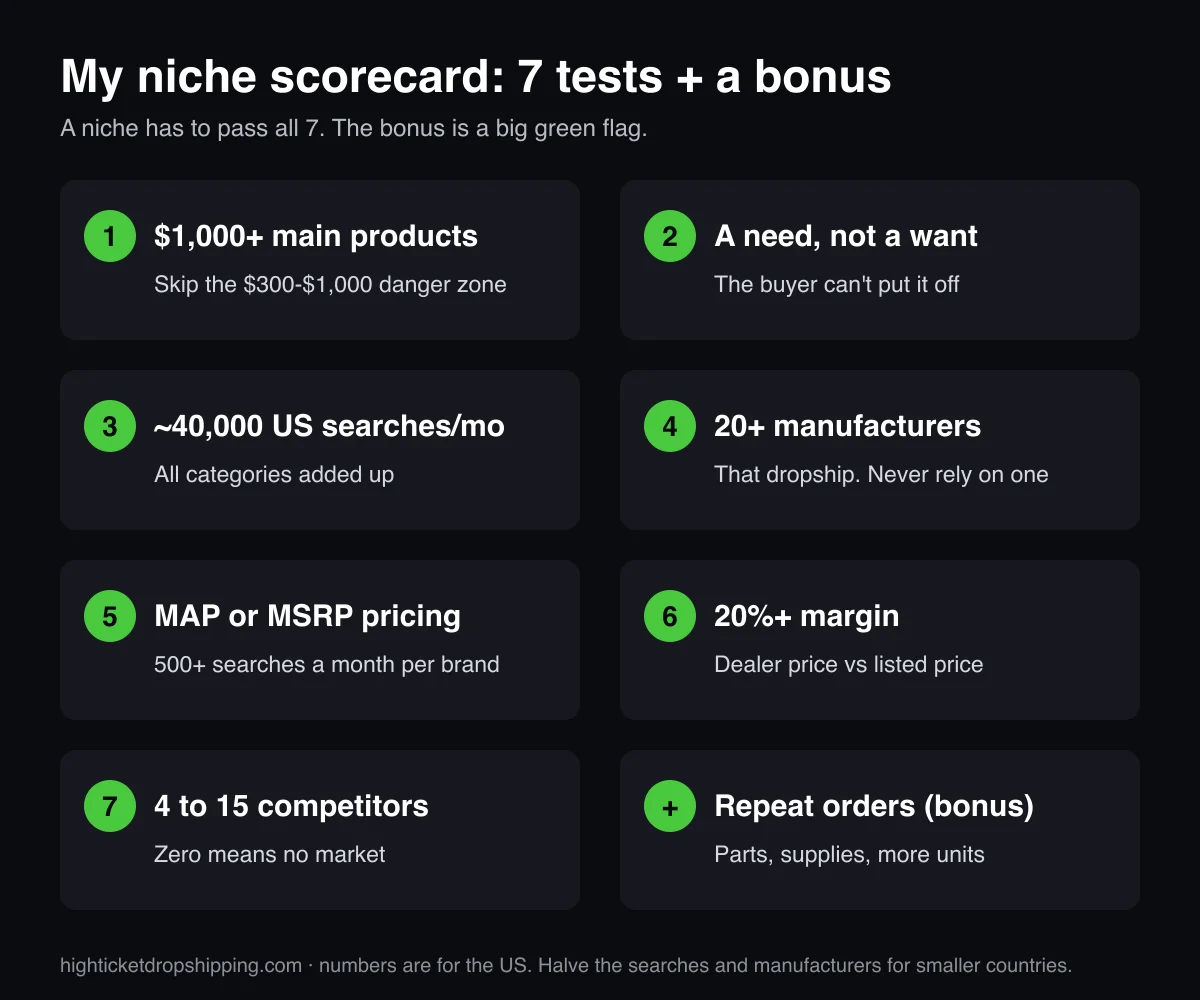
My niche scorecard. Free to use with a link to this page.
Test 1: Main Products Average $1,000 Or More
Your core products should average $1,000 or more. Accessories can be cheaper. The $300 to $1,000 band is the danger zone, and my guide to high ticket dropshipping products explains why.
Test 2: A Need, Not A Want
Businesses have to buy it to do their work, and there’s no cheap stand-in. Saunas and wine coolers are wants. When the economy gets tough, nobody spends $5,000 on a want.
Test 3: About 40,000 US Searches A Month, All Categories Added Up
This is how you check that buyers actually exist. Don’t judge one product. Add up the monthly searches for every category your store would carry.
In the US, I want about 40,000 a month combined. You’ll see how that works with a real niche in the next section.
Test 4: At Least 20 Manufacturers
You want at least 20 manufacturers for everything you plan to sell. Not all of them will approve you. Some brands sell better online than others. And you never want to rely on one supplier.
They have to be willing to dropship. Most are. About 90% of the manufacturers I contact know exactly what I mean, because dropshipping is just a way of shipping orders.
Test 5: MAP Pricing And Brands People Search For
The brands should have a MAP policy, or at least an MSRP. Google a product, and if every store shows about the same price, the price is protected. Nobody can undercut you.
The brands also shouldn’t all sell direct to the end buyer. And each one should get at least 500 searches a month, or it’s not worth your time.
Test 6: At Least 20% Margin
This is the gap between your dealer price and the price you list at. Below 20%, ads are hard to run. That’s before ads and fees. After everything, my store nets about 15-20%.
You’ll only know for sure when the first price list arrives. In my experience, about 90% of manufacturers give at least 20%, and you can negotiate better margins later.
Test 7: 4 To 15 Direct Competitors
A direct competitor sells the same kind of products, or the same brands, as their main focus. In the US, I want at least 4 or 5 and no more than about 15.
Zero competitors is a red flag. It usually means there’s no market. Then weigh what you see. If their sites are outdated, a few more is fine. If they’re all strong, established stores, it’s hard at the start. I sell some brands with 10 to 15 competitors and still sell plenty.
Bonus: Repeat Orders
A niche where businesses come back is a big green flag. Look for parts, supplies, accessories and extra units the same buyer could order again. Repeat buyers mean a lower cost per sale, because you don’t pay to find them twice.
Restaurant Equipment, Scored Live
Restaurant equipment is my public example niche. Here’s how it scores, with real numbers where I have them.
Demand. I added up the US monthly searches for 14 commercial categories a restaurant equipment store would carry:
| Category | US searches a month |
|---|---|
| Steam table | 9,900 |
| Commercial dishwasher | 8,100 |
| Commercial oven | 5,400 |
| Commercial mixer | 3,600 |
| Commercial blender | 3,600 |
| Commercial deep fryer | 2,900 |
| Prep table | 2,900 |
| Commercial convection oven | 2,900 |
| Commercial food processor | 2,400 |
| Commercial toaster | 1,600 |
| Salamander broiler | 1,600 |
| Commercial range | 1,300 |
| Commercial griddle | 1,300 |
| Commercial food warmer | 1,000 |
| Total | 48,500 |
Source: keyword tool estimates (12-month average), United States, English, November 2026.
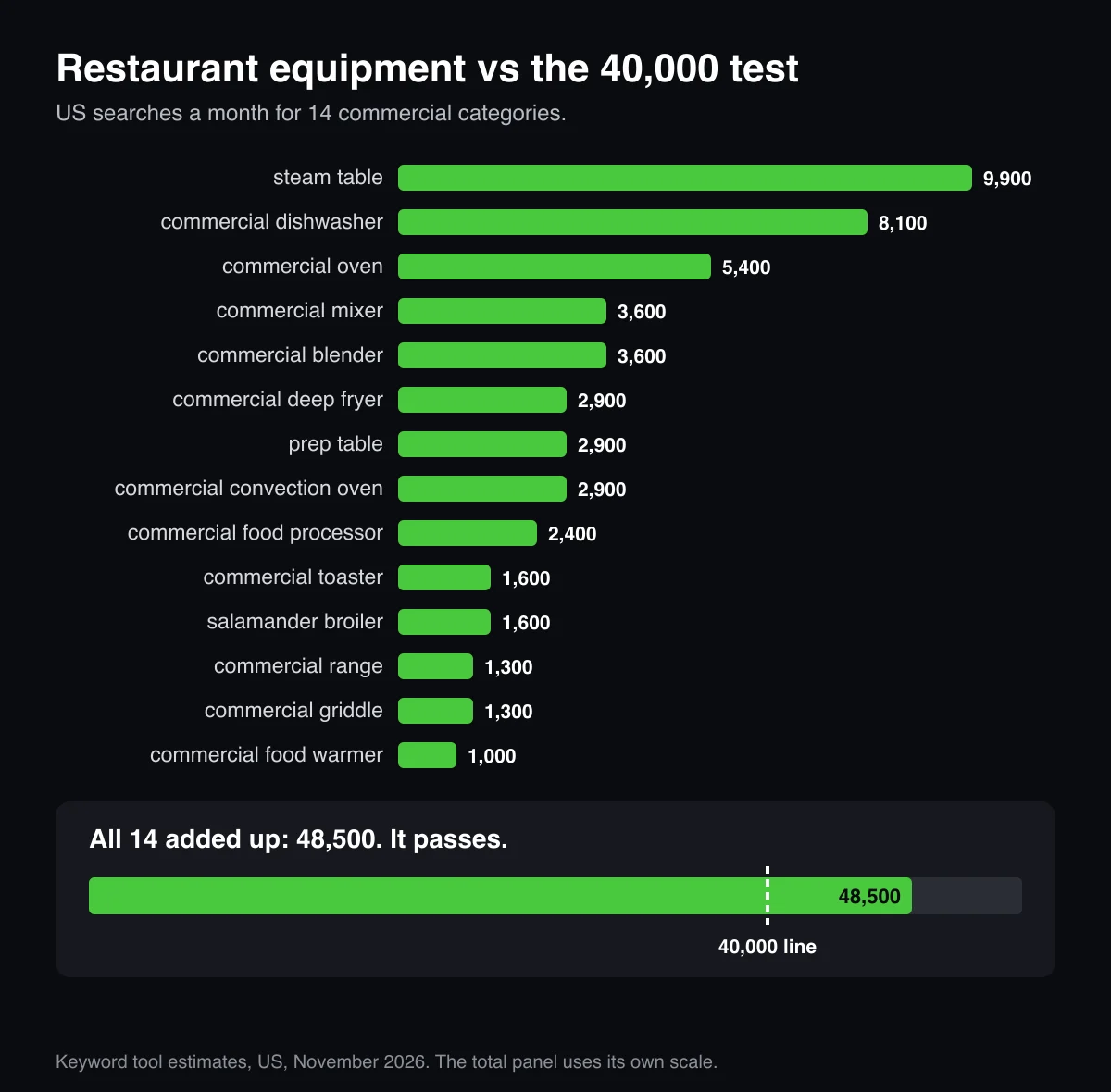
Restaurant equipment against the 40,000 test. Free to use with a link to this page.
It passes, and without padding. I left out broad terms like “food warmer” (22,200 a month), because home buyers search those too. Only commercial searches count.
Notice that no single category comes close to 40,000. The biggest is 9,900. That’s why you count the whole store, not one product.
Price. It passes on the main products, like steam tables and ranges, at about $1,500 to $15,000. Some categories here, like blenders and toasters, are cheaper. They’re the accessories that ship with the main products.
Need. Someone fitting out a restaurant kitchen needs fryers, dishwashers, prep tables and ranges to open. It passes.
Manufacturers, MAP, margin and competitors. These you check yourself, and it takes an afternoon:
- Google 3 of the categories above and open the stores that come up.
- Count the stores that focus on this equipment. You want 4 to 15.
- List every brand they carry. Count them toward 20.
- Check if each brand shows the same price on every store. That’s MAP.
- Look for a dealer form, dealer email or phone number on each brand’s site. That’s a green flag.
Margin comes last, when the first price list arrives. That’s normal. You’ll learn how to get those price lists in my guide to getting dealer approval from US brands.
What Are The Best High Ticket Dropshipping Niches?
The best high ticket dropshipping niches are the ones that pass every test with your own numbers. Nobody can hand you a winner. They can only hand you ideas to score.
If you’re hunting for the best high ticket dropshipping niches 2026 has to offer, here’s the honest answer. The ones that work are rarely on viral lists. They’re the most boring industries: equipment businesses buy, replace and buy again. Good high ticket ecommerce niches look dull from the outside. That’s why most people skip them.
Start with the customer, not the product. Don’t ask “what should I sell?” Ask “who’s my buyer, and what does their business need?” One kind of buyer, with a whole store’s worth of needs, is a niche.
Go Deep, Not Wide
Build a niche store, not a general store. Go deep, not wide.
This is how I win orders over Amazon and Home Depot. A business needs something, and I have everything they want. It’s all relevant. It’s more trustworthy, and it’s a one-stop shop.
Going deep also opens up cross-selling. In a niche store, the main unit, the accessories that go with it and the next piece of equipment are all one click away.
So the high ticket niches worth your time have many products for one kind of buyer, not one product for everybody.
High Ticket Dropshipping Ideas I’d Look At Today
I keep my own niche private. These are ideas to score, not picks. Run each one through the 7 tests with real numbers before you commit.
- Warehousing and material handling. Electric pallet jacks, stretch wrapping machines and case sealers.
- Weather monitoring systems. Weather camera systems, agricultural weather stations and lightning detection systems.
- Nail salon equipment. Pedicure spa chairs, manicure tables, complete pedicure stations and reception sets.
- Commercial safety equipment. Score this one hard on price. A lot of safety gear sells under $1,000.
- Spa and wellness equipment. Treatment tables, massage tables and facial units.
- Security and access control. Gate operators, parking barriers and turnstiles.
- Church and venue seating. Pews and theater seating.
Price ranges for several of these are in my list of 8 high ticket products to sell.
You don’t need experience in the industry, by the way. I’d never worked in mine. It’s the thing you learn as you go.
The Niches That Will Waste Your Time
These are the niches I’d never build a store in.
- Residential appliances and electronics. Fridges and ovens for homes. Fragile, with a lot of returns and shipping damage.
- Custom-made items, like custom furniture. Not really branded, long lead times, no MAP pricing, and the competition is hard to read.
- Restricted products. Drugs, firearms and certain medical equipment. You can’t advertise them, so you can’t grow them.
- The niches every guru teaches. Saunas, cold plunges, pellet grills, pizza ovens, wine coolers and e-bikes. Way oversaturated, with thin margins.
I never researched the first three. The guru niches I did research, and they’re not worth it. There are much better ones out there.
E-bikes are the clearest case. Electric bike dropshippers are everywhere now. Look at any list of high-ticket dropshipping niches 2023 bloggers put out, and you’ll see the same few consumer niches again and again.
I learned the cost of a bad niche myself. My first store sold lawn equipment. The niche wasn’t great and the returns weren’t worth the effort, so I sold it and moved to my current industry.
How Do You Find Dropshipping Niches With Low Competition?
You find dropshipping niches with low competition by looking where nobody wants to look: boring equipment businesses buy. Then you count real competitors instead of guessing.
If you’ve searched for untapped niche markets ecommerce high ticket sellers haven’t found, here’s the truth. They aren’t hidden. Low competition usually just means the existing stores are weak.
Here’s what I look for:
- 4 to 15 direct competitors, not zero.
- Outdated sites. Old design, missing contact details, slow pages. You can beat those.
- Stores with only a few brands. A niche store that carries the whole range is the one-stop shop buyers want.
You’re not looking for the hottest new product. Why reinvent the wheel? Choose what’s already working, and do it better.
Do You Need Experience In Your Niche?
No, you don’t need experience in your niche. It doesn’t have to match your job, your hobbies or anything you’ve done before.
I’d never done this before, and I had no experience in my industry. You learn the products as you upload them and answer buyers’ questions. Manufacturers give you the specs, images and descriptions.
How Long Should Picking A Niche Take?
Picking a niche should take about a week. Use it to score your shortlist, and save every manufacturer’s contact details as you go. You’ll need that list later.
Don’t stretch it to a month. Picking the niche is the step people overthink the most. Pick the one that passes, then move. My full step-by-step guide shows what comes next, from the business setup to the first supplier.
What Happens After You Pick A Niche?
Your niche decides your business name, domain and email, so the setup comes next. Then a demo store, then suppliers. Once products are live, you turn on Google Shopping. Here’s how I run Google Ads for high ticket, with my real numbers.
Your Niche Shortlist This Week
- Write down 3 to 5 kinds of business buyers. Start from a customer, not a product.
- Add up the searches for every category each store would carry. Aim for about 40,000.
- Open the competitors. Count them, list their brands and check the prices.
- Cut every niche that fails a test.
- Commit to the one that’s left.
Want my numbers and the rest of the process in one place? Get my free 60-page guide. And when you’re ready to build, my high-ticket dropshipping course takes you from niche to first order.
FAQ
Are There Any Untapped High Ticket Niches Left?
Yes, there are untapped high ticket niches left, but they don't look exciting. They're boring equipment categories where the existing stores are outdated or carry only a few brands. You won't find them on a viral list. You find them by scoring niches yourself: add up the searches, count the competitors and check the brands. A niche with 4 to 15 weak competitors is wide open.
How Do You Choose A High Ticket Dropshipping Niche?
You choose a high ticket dropshipping niche by process of elimination. Shortlist 3 to 5 ideas, run each one through the same 7 tests, and cut every niche that fails one. That's how I picked mine. Start with the customer, not the product: who buys it, and what else do they need? Give it about a week, then commit to the one that's left.
Which Niche Is Most Profitable In Dropshipping?
No niche is the most profitable in dropshipping for everyone. Profit comes from the margin on each order, and high ticket orders leave more room than $20 products. My store's average order is about $2,090, and it nets about 15-20% after ads, shipping and fees. That's my store, not a promise of yours. Niches with $1,000+ products, 20%+ margins and MAP pricing give you the most room.
Is Dropshipping Dead In 2026?
No, dropshipping isn't dead in 2026. Some of the methods that get pushed are. Chasing trending products for TikTok is like the lottery: you might hit one, but it won't last. Selling equipment that businesses already search for is a different model. My store has done $3M+ in sales since January 2025 this way, mostly to businesses.
What If A Niche Has Zero Competitors?
A niche with zero competitors is a red flag, not a gift. If nobody else sells it online, there's usually no market for it. You want at least 4 or 5 direct competitors in the US, and no more than about 15. Competition means there's a market. Then look at how good their sites are. Outdated ones are easy to beat.
Get My Free 60-Page Guide
The model, my real numbers, and how I pick a niche and get manufacturers to say yes.